Patient of the Week:
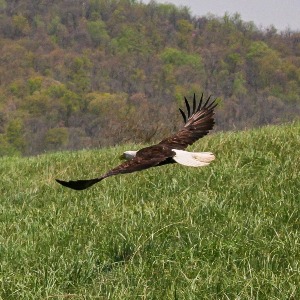
Bald Eagle

Each patient we treat offers an opportunity to learn how we can be better neighbors to our native wildlife.
If you enjoy receiving Patient of the Week, please share it with a friend!

What is a normal or healthy amount of lead?

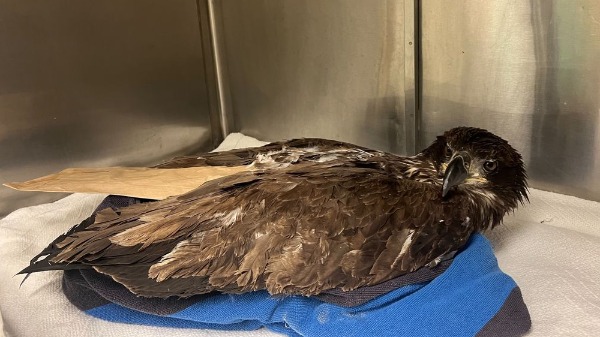
Meet patient #24-9: an immature Bald Eagle, discovered grounded and unable to fly.

Upon examination, our team identified signs of trauma, including blood in the mouth and injuries around the left eye. Additionally, the eagle exhibited an inability to use either leg to stand.

Subsequent bloodwork revealed lead levels in the blood of 27 micrograms per deciliter. What is the normal or healthy amount of lead expected to be found in any animal's blood? Zero.

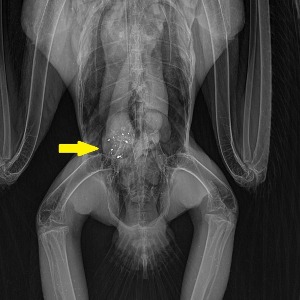
Photo: x-ray of a bald eagle shows lead fragments in stomach. @BRWC 2019

Unfortunately, this scenario is not uncommon, as more than 90% of adult eagles brought to our center have traces of lead in their systems.

While trauma remains the primary reason for eagle admissions, even low levels of lead can compromise their ability to navigate and react swiftly, making them more susceptible to vehicular collisions or other life-threatening situations.

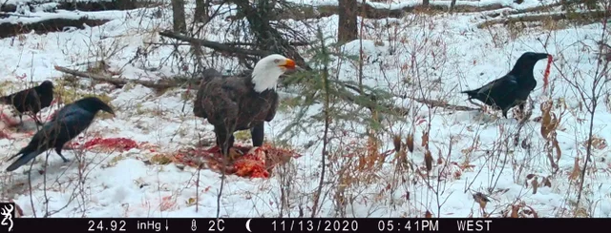
Photo: Bald Eagle consuming a gut pile @r/birdsofprey 2020

Wildlife primarily get lead poisoning when they consume food items with fragments of lead ammunition in them. When lead is consumed, the stomach acid breaks down the soft metal, and it is absorbed into the bloodstream, causing neurologic problems and organ failure.

In our area, lead poisoning cases coincide with deer hunting season, when more animals are shot with lead-containing ammunition. While people often think eagles actively hunt and catch prey, these birds, like many other wild species, are opportunistic scavengers. A fresh carcass is an easy meal they won't pass up.

It only takes a fragment of lead the size of a grain of rice to kill an eagle.

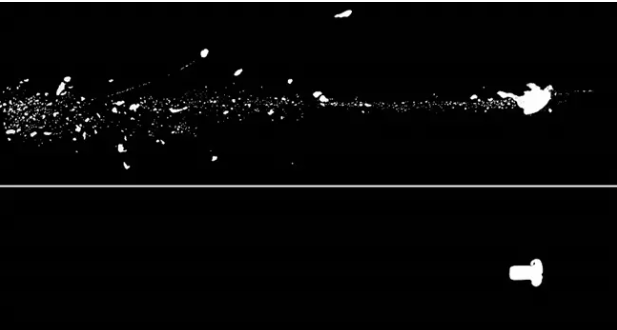
Photo: Comparison of lead bullet (top) vs. nonlead bullet (bottom) when fired into gelatin. @The Peregrine Fund

Due to lead's soft, malleable properties, lead bullets fragment into much smaller pieces after hitting an animal. Studies show that these fragments can travel up to 18" away from the wound channel.

While most hunters trim some distance from the entry wound, many don't realize just how much meat has been contaminated, both for themselves when they consume this meat later, but also for the wildlife they leave to scavenge the gut piles (remains of the hunted animal).

Sadly, this patient did not make it. However, there is still time to save others. Let's come together to protect our wildlife and prevent further loss. 

Take Action: Make the Switch

As advocates for wildlife conservation, Blue Ridge Wildlife Center supports ethical hunting practices and encourages hunters to consider an alternative to lead-containing ammunition. Find out more here: huntingwithnonlead.org

Photo: Bald Eagle released at Sky Meadows State Park @BRWC 2021


Looking for an easy way to help native wildlife? Become a monthly BRWC donor! For as little as $5/month, you can provide year-round, sustainable support that helps us fulfill our mission.


Blue Ridge Wildlife Center
106 Island Farm Lane  | Boyce, Virginia 22620
540-837-9000 | info@blueridgewildlifectr.org

Having trouble viewing this email? View it in your web browser

Unsubscribe or Manage Your Preferences